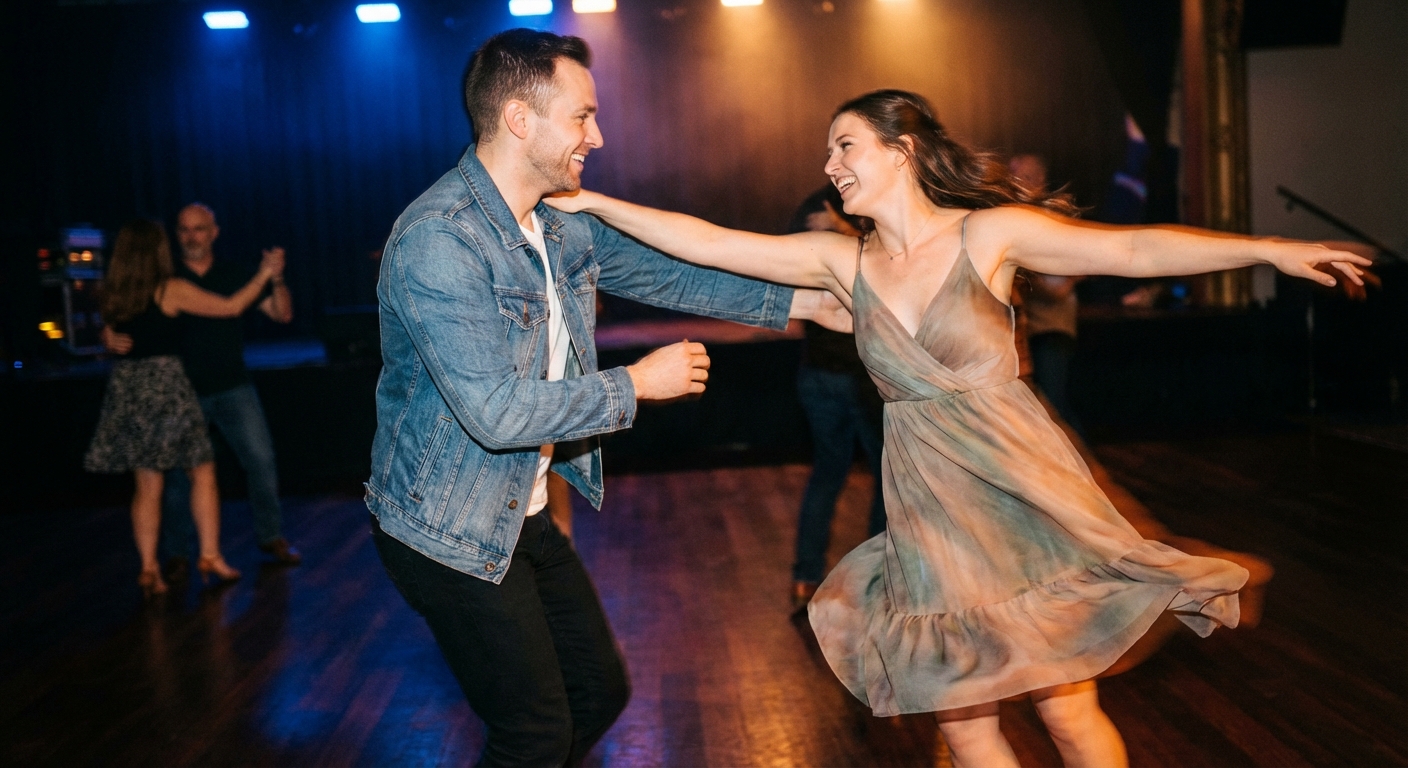
Blues & WCS: A Shared History
West Coast Swing was born from blues music. As Lindy Hop migrated west from Harlem in the 1940s, it met the slower, groovier blues and R&B of Los Angeles dance halls — and a new dance emerged. Blues has remained the common denominator through every decade of WCS evolution.
"Blues music, the original music used for West Coast Swing, has been the common denominator. No matter what decade you were in, you could dance WCS to Blues music." — WestCoastSwingOnline.com
Lindy Hop Emerges in Harlem
African American dancers at the Savoy Ballroom create the Lindy Hop from Charleston and earlier forms like the Texas Tommy. Jazz musicians — Louis Armstrong, Duke Ellington, Count Basie — drive the dance's evolution.
Swing Moves West, Meets the Blues
As swing dancing arrives on the West Coast, dancers adapt to smaller, crowded dance floors and the slower blues and jump blues popular in LA clubs. The slot style develops. Dean Collins films his smooth style in Hollywood movies.
"Western Swing" Is Documented
Laure Haile, National Dance Director for Arthur Murray studios, documents the distinctive Los Angeles swing style and names it "Western Swing." Skippy Blair later popularizes the name "West Coast Swing."
The Dance Evolves with the Music
The coaster step is replaced by the anchor step. WCS absorbs disco, hustle, and funk while keeping blues at its core. The shuffle rhythm — the heartbeat of blues — remains fundamental to the dance's rolling count.
Officially Named "West Coast Swing"
The dance is formally documented under the name West Coast Swing. Competition circuits grow, and blues music remains a staple of competitive events.
California State Dance
West Coast Swing is declared the official state dance of California, cementing its West Coast roots and its deep connection to the blues tradition.
WSDC Founded
Annie Hirsch co-founds the World Swing Dance Council, establishing governance for WCS competitions. Rules eventually formalize blues as a recognized music category option in Jack & Jill finals.
The Great Musical Expansion & The Blues Debate
WCS expands to include pop, hip-hop, and contemporary music. Some fear the blues roots are being lost. Ben Morris launches "Swingin the Blues" at Atomic Ballroom to keep the tradition alive. The community debates whether WCS is drifting too far from its swing and blues identity.
Jordan & Tatiana's Blues Masterpiece
Jordan Frisbee & Tatiana Mollmann perform "Baby What You Want Me to Do" by Etta James — a routine that goes undefeated all year and wins the US Open. A landmark moment that powerfully demonstrates what happens when the world's best dancers return to WCS's blues roots.
The Blues Tradition Endures
Blues rooms thrive at major events. WSDC rules formally offer "slow blues" as a finals music category. Crossover events unite WCS, Lindy, and blues dancers. The rolling count — rooted in blues shuffle rhythm — remains fundamental to every WCS dancer's training.
"Jordan & Tatiana's 2005 routine to Etta James allowed them to go back to the roots of West Coast Swing and the 'Blues' music they started with. It went undefeated all year." — JTSwing.com
The Ongoing Debate: Blues vs. Contemporary
- The 1990s marked a turning point when WCS began absorbing pop, techno, and hip-hop — moving away from its traditional blues, R&B, and soul repertoire.
- Legendary dancer Sylvia Sykes reportedly suggested renaming WCS to "Contemporary West Coast" since "there's literally no Swing music at any WCS nights."
- Others argue WCS is "Modern Swing" — its evolution parallels how jazz evolved into bebop while remaining jazz. The 6-count patterns against 8 beats of music create inherent syncopation rooted in jazz traditions.
- A recurring concern: DJs playing "Blues for Blues' sake without being selective" gives dancers a bad impression. Quality blues selection matters.
- The community remains divided, but blues continues to be played at every WCS event, and its special status is preserved in WSDC competition rules.
WCS History on Wikipedia
Comprehensive overview of WCS origins, the slot style, Lindy Hop roots, and musical evolution from blues to contemporary.
Read on WikipediaSugarpush: A History of WCS, Race, and Gender
CalState thesis exploring the African American roots of WCS, its evolution through race and gender dynamics, and the role of blues music.
Read thesis12 Most Influential WCS Dancers
Big Apple Ballroom's list of the dancers who shaped WCS history, from Jack Carey to Jordan & Tatiana.
Read articleIs WCS Going Too Contemporary?
Jonathan's exploration of the tension between WCS's blues tradition and its contemporary evolution. Essential reading for understanding the community debate.
Read article"Original Music WCS Was Danced To"
Classic Dance Forums thread debating what music WCS was originally danced to. Features passionate arguments from experienced dancers about blues' foundational role.
Read threadWCS: From Classic to Contemporary
Atomic Ballroom's overview of how WCS evolved through the decades, from its blues origins through the hustle era to modern pop — and the challenges of keeping swing feel.
Read articleKey Dancers & Figures
These are the dancers and teachers who have shaped how we dance blues in West Coast Swing — from the pioneers who laid the foundation to the modern champions who keep the blues tradition alive.
Started dancing in 1938. Popularized the name "West Coast Swing" and created the Universal Unit System. The foundation of WCS pedagogy, including how we understand blues rhythm, traces back to her work.
Movement and pattern innovators whose blues performances are legendary. Their musicality and connection epitomize what blues WCS can be. Appeared on Fox's "30 Seconds to Fame" and CBS "Star Search."
Runs the iconic weekly "Swingin the Blues" event at Atomic Ballroom in Irvine, CA. A fierce advocate for blues in WCS who puts his philosophy into practice every Thursday night. Featured in Love N'Dancing.
The only couple holding US Open titles in both Showcase and Classic divisions. Their blues dancing combines athleticism with deep musicality. Co-founders of SwingCouver.
A pillar of the WCS community as dancer, teacher, judge, event director, and DJ. His DJ sets are legendary for their blues selections. Part of the WCS Top Music Team. Serves on the WSDC Board.
The only dancer inducted into five separate halls of fame. Choreographed Taylor Swift's "Love Story" video. Known for blending simple ideas with incredible execution, especially on blues music.
Their "Blues Grooves Workshop" and "Synergy Skills for Blues & WCS" are definitive educational resources. Teaching for 19+ years, specializing in blues footwork, musicality, and African American dance roots. Created the Swing Literacy method.
Brought WCS to mainstream audiences through "So You Think You Can Dance." A movement innovator who demonstrates how blues feeling can transform even the most technical WCS.
1990s innovators who introduced moves like the "Rim Whip" and "Cross Strut." Both in the CA Swing Dance Hall of Fame. Sharlot's "Blues Affair" is a beloved themed room at Jack & Jill O'Rama.
Diego was the first Brazilian to win an official WCS competition at Swing Diego. They've been instrumental in bringing WCS and its blues tradition to the international stage through the Brazilian Open Swing.
Won 2000+ competitions and invented Nightclub 2 Step in 1965. A blues groover at heart whose improvisational style laid the foundation for modern WCS musicality.
Inducted into both the Swing DJ Hall of Fame and the WSDC Hall of Fame. DJs the Late Night Blues Room at multiple major events (Philly Swing Classic, Freedom Swing Dance Challenge). His blues sets are the gold standard for WCS blues nights.
Brought Lindy Hop from New York to Los Angeles. His smoother, slotted style — preserved in dozens of Hollywood films — directly influenced the development of what became West Coast Swing. The original bridge between East Coast swing and the West Coast blues dance floor.
Won the 1949 Harvest Moon Ball dance competition. Annie later co-founded the World Swing Dance Council (WSDC), establishing the governance structure that preserves blues as a recognized music category in WCS competition.
Toured the original Broadway production of "Swing" as dance captain. Gary choreographed for Brokeback Mountain. Their classic style embodies the blues-swing connection.
Blues Music for WCS
From slow, soulful grooves to uptempo shuffles, blues music in WCS spans a wide tempo range. Here are the best playlists, curated lists, and resources to build your blues music library.
Tempo Guide: Blues for WCS
Spotify Playlists
One of the most comprehensive WCS blues playlists on Spotify, covering slow grooves to uptempo shuffles.
Open on SpotifyA focused collection blending blues and soul for WCS, perfect for getting into the groove.
Open on SpotifyThe biggest WCS blues playlist on Spotify. A massive collection covering every shade of blues for West Coast Swing.
Open on SpotifyA curated best-of collection of blues tracks for WCS from the EastonSwing community.
Open on SpotifyA community-curated blues playlist specifically tailored for West Coast Swing dancing.
Open on SpotifyTightly curated selection of blues tracks optimized for WCS social dancing.
Open on SpotifyComprehensive blues collection spanning the full tempo range from slow grooves to uptempo shuffles.
Open on SpotifySlow tempo songs ideal for deep blues connection and working on anchor technique.
Open on SpotifyLive Blues Musicians in WCS
Brother Yusef
Solo guitarist specializing in "fattback blues" — a mix of delta, Chicago, and Louisiana blues with smooth jazz. The most prominent live blues musician in the WCS scene, performing at events worldwide (including Korea's swing dance scene). Six of his songs appear on the Champions' Favorite Blues Songs lists. Hosts a monthly blues dance party at the Idle Hour Bar in LA.
Curated Lists & DJ Resources
Champions' Favorite Blues Songs
WCS Champions voted on their favorite blues songs. Includes slow and fast blues lists with YouTube playlists and Spotify links. Features songs voted by Jordan Frisbee, John Lindo, and 23 other champions.
View on ProSwingDJsWCS Fast Blues: Top 25
The definitive fast blues list curated by WCS Top Music, voted on by champions. Features energetic tracks perfect for shuffles and fast footwork.
Read on MediumWCS Slow Blues: Top 19
The go-to slow blues list for WCS. Deep grooves, heavy connection, soul-stirring tracks curated by the community's top dancers and DJs.
Read on MediumProSwingDJs — DJ Favorites
Professional WCS DJs share their personal top 20 favorite songs from any era. A goldmine for discovering blues tracks used at major events.
Browse DJ favoritesLevelUp WCS Music Playlists
Comprehensive Spotify playlist collection organized by genre. Includes competition playlists, blues playlists, and social dance sets with 500+ songs total.
Browse playlistsClassic WCS Music Lists
StreetSwing's archive of traditional and classic West Coast Swing music, preserving the blues and R&B tracks from earlier eras of the dance.
View archiveBlues Songs Every WCS Dancer Should Know
These are the tracks you'll hear at every WCS event. From Champions' favorites to classic blues standards, knowing these songs will level up your musicality on the dance floor.
Champions' Favorites (Slow Blues)
Champions' Favorites (Fast Blues)
Classic Blues Artists for WCS
Artists to Explore
- The Originals: B.B. King, Etta James, Muddy Waters, T-Bone Walker, Bobby "Blue" Bland
- Guitar Heroes: Stevie Ray Vaughan, Robert Cray, Robben Ford, Albert Collins, Buddy Guy
- Modern Blues: Gary Clark Jr., Joe Bonamassa, Keb' Mo', Jonny Lang, Brother Yusef
- Women of Blues: Bonnie Raitt, Tracy Chapman, Katie Webster, Koko Taylor, Irma Thomas
- Blues-Soul Crossover: Ray Charles, Aretha Franklin, Bill Withers, Sharon Jones, Amy Winehouse
- British Blues: Eric Clapton, The Rides, John Mayer (honorary!)
Understanding Swung Rhythm
Swung rhythm is the single most important concept for dancing blues in WCS. It's the difference between dancing to blues music and dancing with it. If you only learn one thing from this page, make it this.
Straight vs. Swung: Hear the Difference
In straight rhythm, every subdivision is equal — like a ticking clock. In swung rhythm, the beat is split unevenly: a long note followed by a short one, creating a loping, rolling feel. Think DUMM-da, DUMM-da instead of tick-tick, tick-tick.
Straight Rhythm (Pop, Hip-Hop)
Swung Rhythm (Blues, Jazz, Shuffle)
"If straight rhythm is a metronome — tick, tick, tick, tick — then swung rhythm is a rocking chair: a long lean forward and a quick settle back. Blues lives in that rock."
The Triplet Foundation
Swung rhythm comes from dividing each beat into three equal parts (a triplet) instead of two. Play the first and third notes, skip the middle one — the first note now lasts twice as long as the second, giving you the signature long-short feel. In WCS, this triplet subdivision is called the rolling count.
The rolling count triplet. Three even subdivisions where the beat falls on "1." Your body flows through "& a" to land on the beat.
Same triplet, different emphasis. Starting on the downbeat and rolling through. Listen for this in the shuffle pattern of a blues drummer's hi-hat.
The "skipped" triplet — drop the middle note and you get the classic swing feel: long-short, long-short. This is what most people mean by "swung."
How It Looks in a WCS Sugar Push
A sugar push has 8 weight changes across 6 beats: walk, walk, triple step (3 steps), anchor (3 steps). With swung rhythm, the middle step of each triple is delayed — closer to the next beat than the previous one.
Sugar Push — 8 Steps, Swung Feel
Why It Matters for Blues WCS
The Swung Rhythm Cheat Sheet
- Almost all blues music is swung. If you dance with straight timing on a blues song, you're fighting the music instead of riding it.
- Rolling count is how WCS interprets swung rhythm. Skippy Blair codified it as "&a1, &a2" — the triplet feel that lets your body roll through each beat.
- The degree of swing varies. Some blues is heavily swung (almost dotted), some is lightly swung. Listen and match. A good dancer adjusts their swing to fit the song.
- Your triple step IS the swing. When you do a triple step to swung music, the timing naturally becomes long-short-long instead of even-even-even. Don't fight this — embrace it.
- The anchor is where you feel it most. The 5&6 at the end of every pattern is where the swing feel locks in. Let the long-short rhythm settle into your body on every anchor.
- Practice with shuffle blues first. Songs with a clear shuffle feel (listen for the drummer's ride cymbal going TSS..tss, TSS..tss in a long-short pattern) make the swung rhythm impossible to miss. Try "The Thrill Is Gone" or "Stormy Monday."
- Body before feet. The swing starts in your center — a subtle body pulse on the long part of the beat. Your feet follow. If you try to swing just your feet, it looks mechanical.
- Straight vs. swung is a spectrum. Some songs sit right in the middle. WCS's versatility means you can adjust your feel to match any song's swing percentage.
Learn More About Swung Rhythm
Straight vs. Rolling Counts (WCS Online)
Brian B's definitive explanation of the difference between straight and rolling counts, with video examples showing how each sounds and looks in your dancing.
Watch lessonWhat is Rolling Count? (WCS Online)
Detailed breakdown of how the rolling count works, including Skippy Blair's original Universal Unit System framework and how it maps to blues shuffle rhythm.
Read articleUse Rolling Count to Dance the Heartbeat
How to use rolling count not just as a timing tool but as a feeling tool — connecting the triplet subdivision to the body pulse that drives blues WCS.
Read articleUnlocking Your Triple (AdamRitaSwing)
Deep dive into how the triple step connects to blues shuffle rhythm. Why your triple should feel different on blues vs. pop, and how to let the music dictate your timing.
Read articleRolling and Swung Counts (WCS Online)
Video workshop combining rolling and swung counts with practical exercises you can practice at home. Includes side-by-side comparison of straight vs. swung dancing.
Watch workshop48-Beat Blues Footwork Challenge
Swing Literacy's hands-on challenge: create 48 counts of blues footwork choreography using swung rhythm. The best way to internalize the feel is to practice it.
Take the challengeBlues Technique for WCS
Dancing blues in WCS is about feel, musicality, and groove. Here's what makes blues WCS distinct and how to develop your blues vocabulary.
Master the Rolling Count
Blues music uses shuffle rhythm — the beat divided into triplets. The rolling count (a1, a2...) connects directly to this shuffle feel. It's much more common in blues than other WCS genres. This is the key to dancing blues authentically.
Learn rolling countUnderstand 12-Bar Blues Phrasing
Blues music is phrased in 48-beat cycles (6 sets of 8 = 12 bars), unlike the 32-beat phrases of pop music. Recognizing this longer phrase structure lets you anticipate musical changes and hit them in your dance.
Learn phrasingDance Low & Groovy
Especially with "dirty" blues, dancing low brings out the groovy sound. Hit accents inside of moves rather than with all-out breaks — most blues music doesn't just stop for a break, so find ways to accent within your patterns.
Blues tipsBlues Footwork Variations
Become comfortable with footwork variations to create energy. Shag-inspired footwork, kick ball-change, and hold ball-change emphasize upbeat pulses and the swung rhythm that defines blues WCS.
Syncopation elementsBody Pulse & Grounding
Blues WCS emphasizes a deeper, more grounded connection. The body pulse — a subtle up-down movement through the center — helps both partners feel the music together and creates the intimate quality that defines blues dancing.
Blues Grooves WorkshopFull Musicality Resource
WCS Online's comprehensive musicality section covers counting, phrasing, texture, dynamics, and how to respond to blues music's unique characteristics in your dancing.
All musicality lessonsQuick Tips for Dancing Blues WCS
- Rolling count is king. Blues music is much more likely to have a rolling count than other WCS genres.
- Stay grounded. Lower your center of gravity to match the earthy feel of blues music.
- Accent inside moves. Blues rarely has hard breaks — find subtler ways to hit the music.
- Use body isolations. Chest, rib cage, and hip isolations add texture to your blues dancing.
- Study Shag dancers. They provide great inspiration for how to use footwork to bring out blues energy.
- Practice at 80–100 BPM. This is the sweet spot for social blues where you can work on connection and feel.
- Listen to 12-bar patterns. Count the 6 sets of 8 and note phrase changes — that's where the magic happens.
Essential Videos
Watching great dancers interpret blues music is one of the best ways to learn. Here are the key video resources and channels for blues WCS.
WCSVideos.com
The largest curated archive of West Coast Swing competition videos. Browse by pro dancer, event, or year. Search for blues performances by filtering for specific dancers known for their blues style.
Browse the archiveUS Open Swing Dance Championships
The Super Bowl of WCS. Videos from decades of US Open performances, including iconic blues routines by Jordan & Tatiana, Kyle & Sarah, Robert Royston, and more. Many available on YouTube.
Official siteAustin Westie Academy's WCS Guide
A curated Medium article pointing to the best starting points for a WCS YouTube binge, including iconic blues performances and championship moments.
Start the rabbit holeWCS Online YouTube Channel
Brian B & Megan teach over 20,000 dancers per year online. Free YouTube videos covering blues-specific techniques including rolling count, blues footwork, and musicality.
Dancing to BluesJordan & Tatiana (JT Swing)
580K+ TikTok followers. Their blues performances are masterclasses in connection and musicality. Check their online platform JT Swing TV for structured learning.
The OPEN Swing Dance Championships
The oldest international swing dance competition, now in its 41st year. Classic Division routines heavily feature blues. Official YouTube channel publishes first-place performances.
Liza May YouTube Channel
WCS music curation channel updated almost daily. Monthly song lists with cutting-edge music selections for social dancing and competition, featuring regular blues picks.
Find on YouTubeTop 30 Swing Dance YouTubers (Feedspot 2026)
Curated list of the top swing dance YouTube channels, ranked by activity and subscribers. A one-stop starting point for discovering WCS video content.
View rankings200 Favorite WCS Videos (2023)
A massive Pinterest collection of favorite West Coast Swing performances, organized for easy browsing. Many blues performances featured throughout.
Browse collectionMust-Watch Blues WCS Performances
Jordan & Tatiana — US Open Classic
The gold standard of blues WCS. Their 2001 US Open Classic remastered alongside later performances. The routine that defined what blues WCS could be.
Watch on YouTubeJordan & Tatiana — BudaFest 2018 Pro J&J
Improvised Pro Jack & Jill at one of Europe's biggest WCS events. Pure connection and musicality.
Watch on YouTubeRobert Royston & Melissa Rutz — Grand Nationals
The viral musicality video that became one of the most shared WCS clips in 2016. "WCS musicality at its finest."
Watch on YouTubeKyle Redd & Sarah — "How Long Can a Fool Go Wrong"
James Cotton blues at GNDC 2002 Classic division. The kind of bluesy routine that shows why the Classic division matters.
Watch on YouTubeMyles & Tessa — MADjam 2012 Showcase
The creators of "Blues Grooves Workshop" in a competition showcase that demonstrates their deeply rooted blues style.
Watch on YouTubeBen Morris & Virginie Grondin — BudaFest 2018
The "Swingin the Blues" founder in an improvised Pro J&J at BudaFest. Blues musicality from one of WCS's greatest.
Watch on YouTubeJohn Lindo & Jessica Cox — Demo of the Stars
Powerful, grounded WCS from a WSDC board member whose DJ sets and dancing define the blues side of the community.
Watch on YouTubeWayne & Sharlot Bott — WCS Exhibition
Historic footage of the classic era innovators who introduced the Rim Whip and Cross Strut. See where modern WCS blues vocabulary began.
Watch on YouTubeWayne & Sharlot Bott — 2000 Capital Swing Winners
Classic Division winners at Capital Swing 2000. Blues-era WCS at its peak from two Hall of Famers.
Watch on YouTubeWCSVideos.com — Full Pro Archives
Browse hundreds more performances organized by dancer. Deep-dive into any pro's full competition history.
Learn Blues WCS Online
From free articles to structured online courses, there's never been more ways to study blues in West Coast Swing from home.
West Coast Swing Online
Brian B's comprehensive free resource with articles on blues musicality, rolling count technique, footwork syncopation, and how to dance to blues music specifically. An essential starting point.
Swing Literacy — Blues Grooves Workshop
Myles & Tessa's signature workshop: 1-hour of progressive footwork drills yielding 10+ combos inspired by Shag, Tap, and Vernacular Jazz. Includes historical context about African American roots of WCS.
View workshopBlues Breakthroughs Live
SwingLiteracy's live online event focused on breakthrough moments in blues WCS. Features guest coaching sessions with blues musicians like Brother Yusef.
Learn moreJT Swing Online Classes
Jordan Frisbee & Tatiana Mollmann's online platform with structured WCS courses. Their blues interpretation and musicality work is world-class.
JT Swing TVDanceFlix: Synergy Skills for Blues & WCS
Myles & Tessa teach "puppeteering" techniques for Blues and WCS — connecting deeply with both your partner and the music simultaneously. Available on DanceFlix Silver/Gold plans.
View on DanceFlixThe Blues Room
While focused on blues dance (not WCS), this platform offers 59 courses and 869 classes covering blues fundamentals, musicality, and solo skills that directly apply to blues WCS. 14-day free trial available.
Explore coursesAdamRitaSwing — Unlocking Your Triple
Deep dive into how the triple step connects to blues shuffle rhythm. Essential reading for understanding why the rolling count matters in blues music.
Read articleDanceVision — Best Practice Music
Recommendations for the best blues songs to practice WCS to, organized by difficulty level. Includes BPM ranges and tips for what to focus on with each song.
Read guideMusic4Dance WCS Catalog
Searchable database of songs categorized by dance style and BPM. Filter for blues songs in the West Coast Swing tempo range.
Search catalogBody Isolations for Blues
Rib cage pops, shoulder drops, hip settling — the building blocks of blues expression in WCS. Essential for adding texture and soul to your blues dancing.
Learn isolationsWCS Styling Checklist
Comprehensive checklist covering ribcage isolations, shoulders, upper body angles, and the concept of contrast — key to making blues styling pop.
View checklist48-Beat vs 32-Beat Phrases
Why blues music uses 48-beat phrases (12-bar blues = 6 sets of 8) instead of 32-beat phrases (4 sets of 8). The key to blues musicality in WCS.
Understand phrasingBlues Breakthroughs (30-Day Course)
Swing Literacy's 30-day online course to demystify blues music and conquer it on the dance floor. Self-guided multimedia content plus 4 live coaching calls. 100+ participants per cohort.
View courseLibrary of Dance — WCS
Comprehensive reference covering WCS history, basic patterns, music, and technique. An excellent academic-style resource with clear explanations and historical context.
Read resourceRobert Royston — Howcast WCS Series
8x US Open Champion Robert Royston teaches WCS fundamentals on Howcast. His approach emphasizes musicality and the blues-rooted basics of the dance.
Watch seriesDr. Matt's WCS Move Archive
Comprehensive archive of WCS steps and moves with video clips, organized by pattern type. A practical reference for building your vocabulary.
Browse movesDanceTime WCS Technique Articles
In-depth articles on rolling count, footwork technique, and the fundamentals that underpin blues WCS. Includes embedded video demonstrations.
Read articlesSynergy Skills: Puppeteering for Blues & WCS
Myles & Tessa's video course on deeper partner connection techniques for Blues and WCS. Available as a digital download from Canadian Swing Champions.
Purchase courseEvents & Venues
From weekly blues nights to international conventions with dedicated blues rooms, here's where you can experience blues WCS in person.
Swingin the Blues
Ben Morris's legendary weekly Thursday night at the Atomic Ballroom. The premier blues WCS social dance in Southern California. Free lessons at 8:15pm, dancing 9pm–midnight.
Event detailsJack & Jill O'Rama
Features "Sharlot's Blues Affair" — a themed blues room alongside other specialty rooms like "Lindo's Favorites." The most Jack & Jill divisions of any WCS event. June in Garden Grove, CA.
Official siteBudaFest
One of the world's premier international WCS events. Features top-tier competition with blues music prominently featured in social dancing and Jack & Jill finals. Now in its 15th year.
Official siteTrilogy Swing (+ Blues/Fusion Room)
A four-day WCS event that partners with Dance Gumbo, Greenville Fusion, and RDU Blues to offer a dedicated Blues/Fusion Room. Features 6 hours of blues technique workshops plus 12 hours of Fusion social dancing (10pm–4am both nights). September in Raleigh.
Official siteBoston Tea Party Swings
The only remaining crossover swing event in the US, featuring WCS, Lindy Hop, Balboa, and Blues. A unique opportunity to experience the connection between all four dance forms.
Official siteCanadian Swing Championships
Multi-swing event where WCS, Lindy Hop, Balboa, Blues, Boogie Woogie, and Rockabilly Jive all come together. The blues–WCS connection is alive and well here.
Official siteFreedom Swing Dance Challenge
Features a "Late Night Blues Room" with DJ John Festa. Workshops from top pros including Thibault & Nicole Ramirez. January event near Philadelphia.
Official siteBlue Moon Swing
Free weekly event at Neon Boots Saloon (historic Esquire Ballroom). Thursdays 9pm–midnight. Lessons at 8:15pm. Blues, soul, and classic swing music in a beautiful venue.
Official siteEvolve Swing
UK-based WCS school offering periodic blues-specific workshops. Past events include a Blues Workshop with All Star Teachers Kevin & Aggie Town plus guest DJ sets.
Official siteMADjam
Major East Coast WCS competition featuring Champions Jack & Jill and Strictly Swing divisions. Consistently produces iconic blues performances. Many documented on WCS Videos.
Watch videosBoogie by the Bay
Premier Bay Area WCS competition. Champions J&J and Strictly Swing divisions often feature blues music. Regularly attracts top-tier competitors.
Watch videosSummer Hummer
Long-running WCS event featuring Champions divisions and social dancing. Blues music is a fixture of the late-night social rooms and competition DJ rotations.
View on Scoring.dancePhilly Swing Classic
East Coast event known for its DJ quality and late-night blues rooms. Features DJ John Festa's legendary blues sets.
Official siteDanceUs.org — Swing Festivals Worldwide
Comprehensive directory of swing dance festivals, exchanges, and events worldwide for 2025–2026. Filter by region to find WCS events near you.
Browse eventsMeetup.com — WCS Groups
Find local West Coast Swing groups and social dances in your area. Many local groups host blues-themed nights and events.
Find a groupCommunity & Organizations
Join the conversation, find local dancers, and stay plugged into the world of blues WCS.
World Swing Dance Council (WSDC)
The international governing body for WCS. Maintains the points registry, hall of fame, and competition rules. Blues is recognized as a core music category in competition guidelines.
California Swing Dance Hall of Fame
Honors the dancers who built WCS from its blues roots to today. Inductees include Skippy Blair, Ben Morris, the Schwimmer family, Kyle & Sarah, and many more.
View inducteesScoring.dance
Track WCS competition results worldwide. See which dancers are competing and follow the competitive circuit, where blues songs feature in every event's DJ rotation.
View resultsDance Forums — Swing Discussion
Active forum with threads about WCS blues history, the "original music" WCS was danced to, technique discussions, and community debates about blues in modern WCS.
ProSwingDJs.com
The hub for professional WCS DJs. Their curated blues lists, champions' favorites, and DJ resources are invaluable for dancers wanting to deepen their blues music knowledge.
Visit siteMusic4Dance Blog
Detailed analysis of dance music including tempo ranges, music categorization, and the ongoing discussion about what constitutes "proper" WCS blues music.
Read blogThe Smallroom Dancer
Dedicated to supporting Blues, West Coast Swing, and Fusion dance communities in the Great Lakes region. A bridge between the blues dance and WCS worlds.
Visit siteSwingDJs Forum
Forum for WCS DJs discussing song selection, blues playlists, BPM ranges, and what music works for different crowds and competition levels.
Visit forumSwing Literacy Teacher Development
Myles & Tessa's program for WCS teachers, emphasizing historical roots, blues musicality, and responsible pedagogy that respects the African American origins of the dance.
Learn more